There’s an increasingly urgent issue that I call the judgment gap.
By this I mean: the growing distance between what we think judgment is (e.g. a personal act of reasoning, something we own) and what it is in practice (shared between us and AI, driven by factors outside our awareness).
This gap has always been there: for decades, behavioral science has shown how our judgments are influenced by our environment and the people in it.
But the rise of AI is introducing a whole new set of influences that are making the gap much harder for us to ignore. And it’s radically challenging our ideas of what “human judgment” even is.
The Judgment Gap Substack blends behavioral science, literature, and philosophy to shed light on how we judge one another, ourselves, and AI.
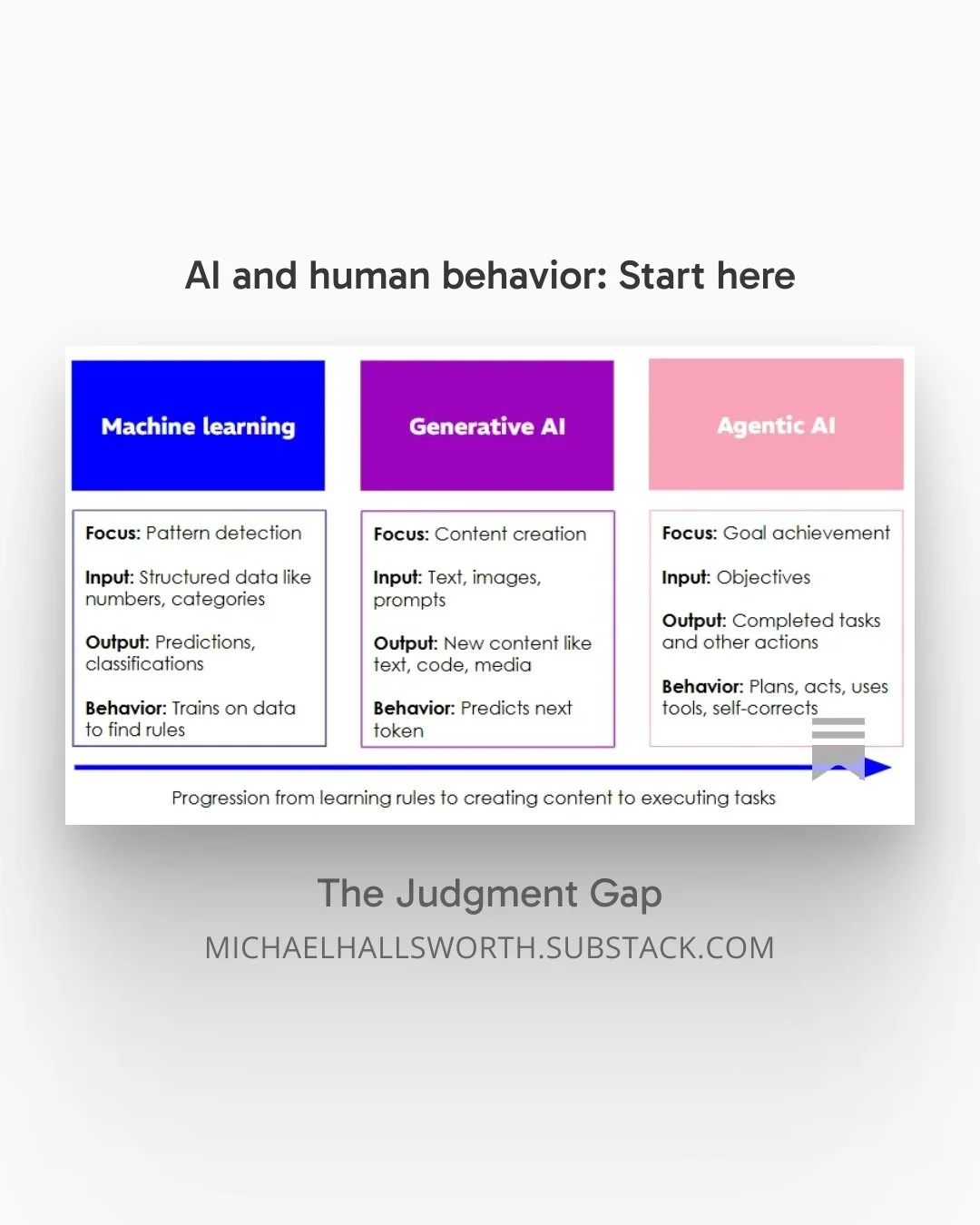
I’m going to start with a series that explains my new course in “AI and human behavior” at the University of Pennsylvania, week by week. I’ll be using the Augment-Adopt-Align-Adapt framework to beat a path through the blooming, buzzing profusion of AI research.
I’ll also be sharing insights drawn from my recent book, The Hypocrisy Trap, just out with MIT Press. It explores why our attempts to call out hypocrisy often backfire - and how we can judge more wisely. I’ll be discussing the gap between how we judge ourselves and others, between how we judge AI and humans, and the many hypocrisies that are growing up around AI.
Finally, I will try to go beyond simply discussing studies, and look for the real-world implications, drawing on 20 years of applying behavioral science in practice.